

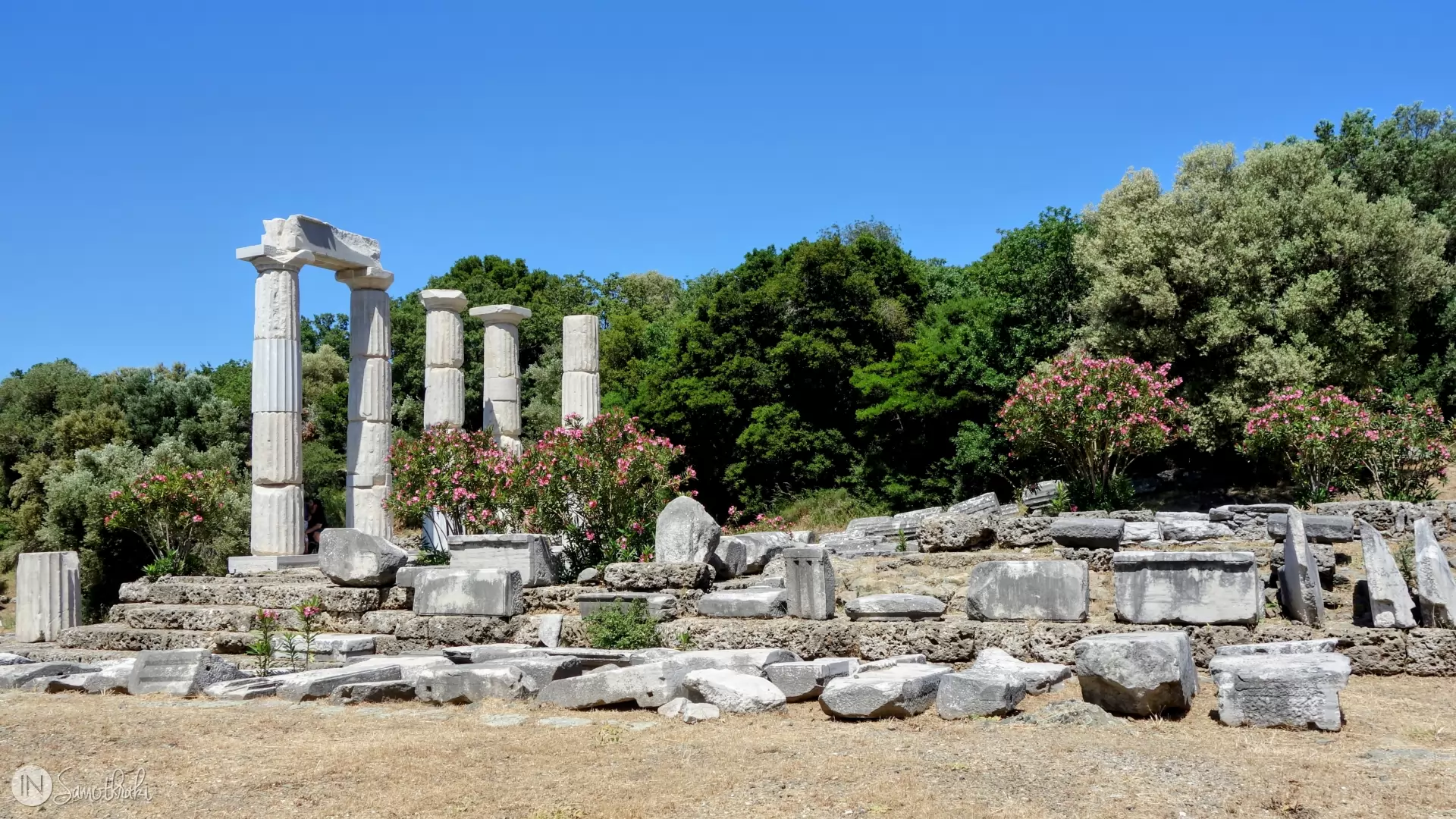
The Sanctuary of the Great Gods is the most important tourist attraction in Samothraki and one of the most interesting archaeological sites in the entire North Aegean region. The island may not be as well-known now, but in ancient times, it was the center of religious ceremonies that made it famous throughout the ancient Greek world.
Price and Visiting Hours
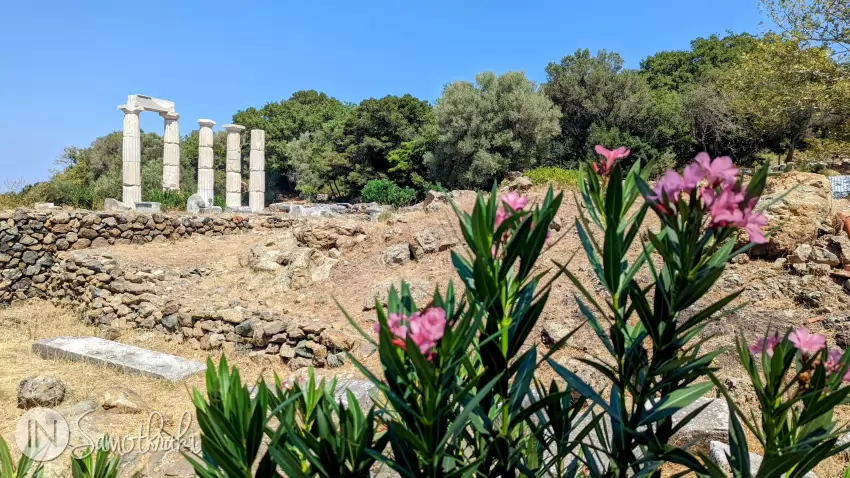
The Sanctuary of the Great Gods is located in the north of the island, in Paleopoli, 6.5 km from Kamariotissa and about 400m inland from the shore. The archaeological site spans an area of about 50,000 m² on a forested slope of Mount Saos, between the valleys of two rivers. The altitude is around 50m, and some spots offer a beautiful view of the sea.
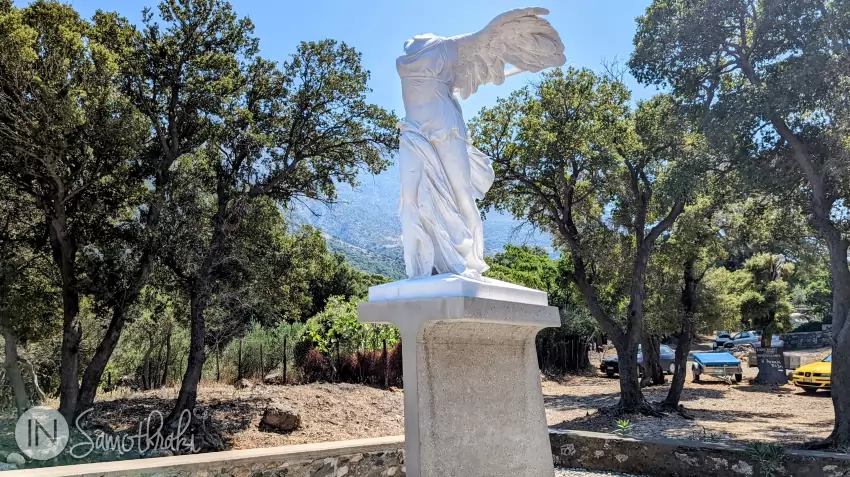
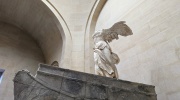
A paved, tree-shaded path begins near the parking lot in front of the Agia Paraskevi church. Following it, after about 200m, you'll reach the small Archaeological Museum, next to which stands the copy of the statue of Nike of Samothrace. I recommend starting your visit with the museum; it will help you get a general idea of what the Sanctuary of the Great Gods once represented.
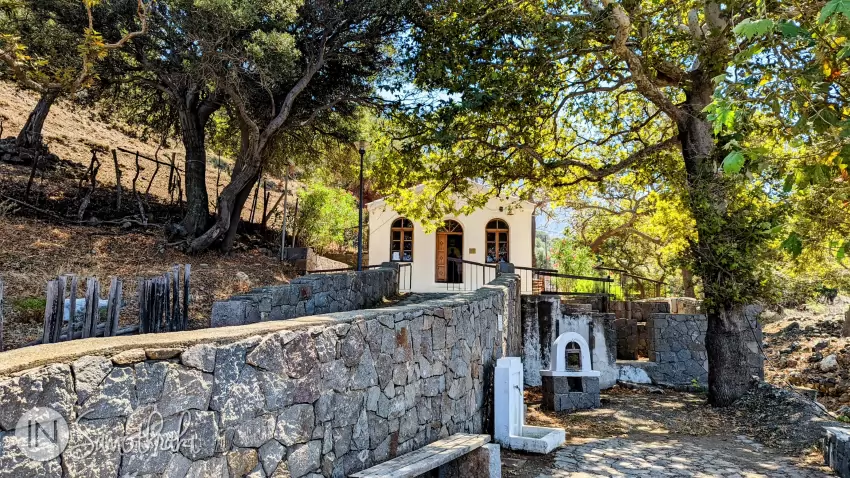
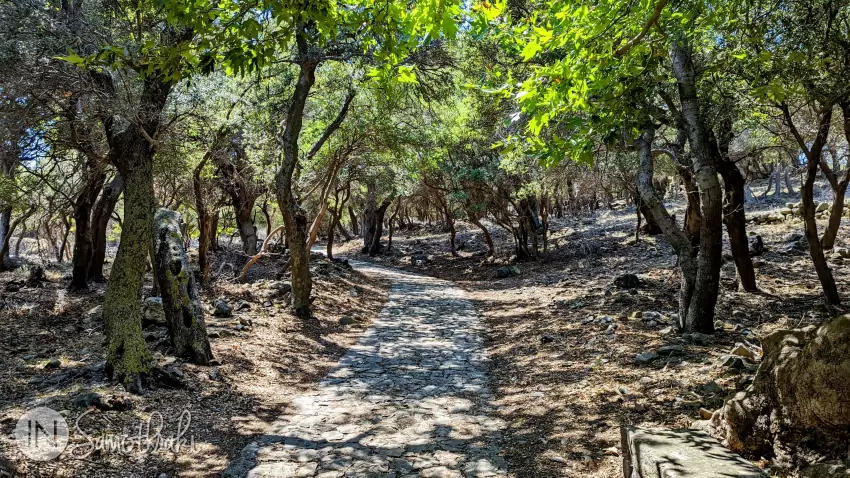
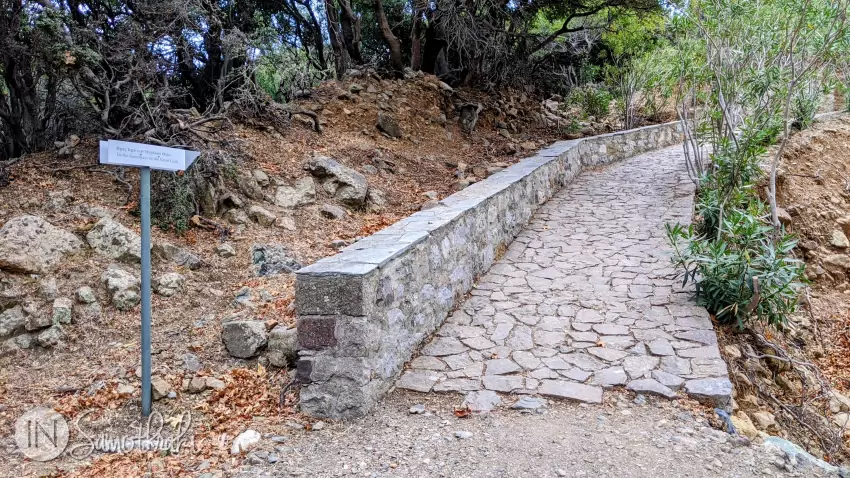
To reach the archaeological site, follow the paved path, and in a few minutes, you will find yourself at the entrance gate.
The entrance ticket to the Sanctuary of the Great Gods also includes access to the Archaeological Museum. Pets are not allowed.
Ticket Prices:
- Adult: €10
- EU citizens over 65: €5 (only from November 1 to March 31)
- EU citizens under 25: free
- Non-EU citizens under 18: free
Visiting Hours:
- April 1 - October 31: Monday-Friday and Sunday 8:30 AM - 3:30 PM, Saturday 1:00 PM - 8:00 PM
- November 1 - March 31: Wednesday-Sunday, 8:30 AM - 3:30 PM
- Good Friday: 12:00 AM - 5:00 PM
- Closed: Easter Sunday, May 1, and public holidays
Free Admission Days:
- March 6
- April 18
- May 18
- October 28
- The first and third Sunday of every month (from November 1 to March 31)
History of the Sanctuary of the Great Gods
The Sanctuary of the Great Gods dates back to an era preceding the arrival of the Greeks in Samothraki. Herodotus (who was himself initiated into the Mysteries of the Kabeiri) mentions that the Pelasgians were the ancient inhabitants of Samothraki who passed on their religion to the later settlers of the island. It is believed that the last pre-Hellenic population, who lived on the island in the Late Bronze Age (around 1000 BC), were the Thracians. In 700 BC, when Greek colonists from Asia Minor arrived in Samothraki, they mixed with the local population and adopted and adapted the old religious beliefs. They built their city in Paleopoli (which literally means "old city"), east of the already existing sanctuary. The Thracian language continued to be used as a sacred language in the rituals until the 1st century BC.
Evidence of religious activity at the Sanctuary of the Great Gods spans over a millennium, from the 7th century BC to the end of the 4th century AD, covering the Homeric, Archaic, Classical, Hellenistic, and Roman eras. During the latter two periods, the sanctuary reached its maximum extent, expanding westward, as evidenced by most of the monuments in the complex, built in the 4th and 3rd centuries BC. The kings of Macedon, Egypt, and Thrace took the sanctuary under their protection and enriched it with monumental, luxuriously decorated marble structures dedicated to the Great Gods.
In the 3rd and 2nd centuries BC, Samothraki became a renowned religious center throughout the Greek world, also called the "Delos of the North Aegean". Devotees from all over came to the island to be initiated into the sacred Mysteries. The fame of the Mysteries of Samothraki was surpassed only by that of the Eleusinian Mysteries.
The religious center continued to operate in the following centuries, being restored by the Romans after the pirate attack and plunder in 84 BC and after the destruction caused by the earthquake in 200 AD.
With the establishment of the Christian religion, the Sanctuary of the old gods began to decline, and by the end of the 4th century AD, it was abandoned. The earthquake in the middle of the 6th century dealt the final blow, destroying what remained standing.
The site re-entered the global spotlight only in 1863 with the discovery of the statue of the goddess Nike, today considered one of the most beautiful works of the ancient world. French and Austrian archaeologists conducted excavations at the end of the 19th century. Another Franco-Czech research campaign followed between 1923 and 1927. The most important were the excavations by American archaeologists, started in 1938 by Karl Lehmann and continued in the second half of the 20th century after World War II. Recently, Emory University in Atlanta has conducted research campaigns every summer at the archaeological site, discovering new elements that help complete the still unclear image of the sanctuary.
Who Were the Great Gods of Samothrace?
Strabo's record in the 1st century, in the 7th book of his Geography, remains relevant today: "Many authors have identified the gods worshipped in Samothrace with the Kabeiroi, though they cannot say who the Kabeiroi truly are."
The names, number, and origin of the Great Gods of Samothrace remain largely unknown to this day. It is known that they were venerated before the arrival of the Greeks, so their roots are not found in Hellenic mythology. The cult of the Kabeiroi was also present elsewhere, including the islands of Lemnos (where it was associated with Hephaestus) and Imbros, as well as Thessaloniki and Thebes. According to some theories, the word kabeir has its origin in the Semitic kabirim, meaning "almighty".
The names of a few gods only appear mentioned late, in the Hellenistic era. Today, you will recognize them in the names of hotels (e.g., Axieros and Axiokersa hotels in Chora) or even boats (Axieros) in Samothraki.
The central position was held by Axieros, the goddess of fertility, equivalent to the Great Mother and similar to the Phrygian deity Cybele. Upon their arrival, the Greeks associated her with Demeter, the goddess of the harvest. She was also called Elektra, as the personification of light battling darkness. Axieros was usually depicted seated on a throne and framed by two lions. She was a mountain deity, and her adoration took place on primitive altars represented by sacred rocks, where offerings were made to her. Her cult was also associated with magnetic iron rings worn by the faithful in the sanctuary, through which they felt in contact with the goddess's power.
Linked to Axieros was Kadmilos or Kasmilos, (probably her husband), an ithyphallic god of fertility, identified by the Greeks with Hermes. His distinctive symbols were the ram's head and the caduceus (staff entwined with two snakes).
To this first couple (Axieros-Kadmilos) is added a pair of chthonic (underworld) gods: Axiokersa and Axiokersos, associated with the Olympian gods Hades and Persephone, depicted as a young woman and a bearded man. The myth of the abduction of Persephone by Hades (later replaced by the abduction of Harmonia by Kadmos) was one of the religious spectacles held in the sanctuary's theatre during the annual festivals.
Two more deities complete the picture: the Kabeiroi, the twin demons who were identified by the Greeks with the Dioscuri (Castor and Pollux), and who were the protectors of sailors and merchants.
Another interpretation identifies the Kabeiroi with the mythical brothers Dardanus and Iason (the latter being considered the founder of the Mysteries in Samothrace), the sons of Zeus and the Pleiad Elektra, also associated with the protection of those at sea. Their sister, Harmonia, is a central figure in the island's mythology. Samothraki it is believed to be where the sacred marriage between her and Kadmos took place, the representation of which was enacted in the ritual ceremonies.
Different evidence also attests to the cult of Hecate (under the name of Zirynthia), Aphrodite, and Athena.
Secret rituals and ceremonies, known only to the initiated, were dedicated to this group of Great Gods.
The Mysteries of the Kabeiroi
Although the mentions of ancient authors (including Homer, Aristophanes, Plato, and Plutarch) regarding the initiation rites in Samothrace are numerous, they are quite vague and generally refer only to the first stage of initiation. Little is known today about the religion of the Kabeiroi. The veil of mystery covering it allows only a few images to be glimpsed and envelops the island in a mystical aura. The fact that so little is known is not accidental: the initiated were obligated to keep the content of the initiation ceremonies secret. Revealing it would have incurred the death penalty.
One important thing is known, however: unlike other mystery cults in Greece, those in Samothrace had a universal character. All people could participate and be initiated, regardless of sex, age, wealth, social class, or nationality: men or women, adults or children, slaves or free people, Greeks or foreigners.
The main role of the Kabeiroi Mysteries was to make people better, to purify them, and also to protect them from dangers at sea. The initiated received the power to overcome difficulties and defeat their enemies. Most likely, as at Eleusis, the Mysteries promised happiness in the afterlife. Diodorus Siculus mentions that "the initiates became more pious, more just, and better in all things". Those who survived shipwrecks deposited offerings at the sanctuary in Samothrace. Excavations have revealed that many of these were shells, fishhooks, fishing nets, or locks of hair of fishermen and sailors who asked for or gave thanks for the gods' protection.
Among the most famous mythical and historical figures believed to have been initiated into the Mysteries of the Great Gods are Odysseus, Hercules, Orpheus, Iason, Theseus, Castor and Pollux, Agamemnon (a fragment of a relief found in Samothrace and now in the Louvre apparently depicts the inititiation of Agamemnon), Herodotus (who left some clues about the nature of the ceremonies), the Spartan general Lysander, Philip III of Macedon, Lucius Calpurnius Piso Caesonius (father-in-law of Julius Caesar), and many Athenians.
According to tradition, Philip II and Olympias, the parents of Alexander the Great, met and fell in love at the religious ceremonies of Samothrace, and Alexander is said to have been conceived on the island itself. Moreover, the construction of the monumental buildings in the sanctuary is associated with the era of Philip II (4th century BC) and his successors.
It is believed that public festivals dedicated to the Great Gods took place every year, in mid-summer (archaeologist Karl Lehmann mentions the month of July in a treatise) when, as today, the island was full of visitors. Cities sent representatives (theoroi) to deposit offerings for the well-being of their homelands. According to some theories, remnants of the sacred ceremonies might be identified today in the festival that takes place on St Paraskevi's Day, 26 July, right at the small church near the sanctuary.
During the public ceremonies (which, according to some, lasted 3 days, and according to others, 9 days) the procession of pilgrims passed from one altar to another, bringing offerings, sacrificing animals, making libations, and offering prayers. Very many altars, round or square, have been found throughout the sanctuary. Offerings to the Great Gods of Samothrace took various forms - from constructions and altars to marble, bronze, or clay vessels and statuettes.
It seems that during the Mysteries, all fires on the island were extinguished until a boat arrived from Delos, bringing the sacred fire with a torch. Fire was a symbol of purification and the beginning of a new life.
Initiation into the Mysteries was not mandatory for all visitors to the sanctuary, as it was, for example, at Eleusis, and it did not only take place during the annual festivals but could happen at any time.
As with the Eleusinian Mysteries, there were two stages of initiation: the principal initiation (myesis, from the verb myo, meaning "to close the eyes") and the vision (epopteia, the initiated being called epoptai, meaning "those who see"). At Eleusis, however, obtaining the second degree was mandatory for the completion of the initiation and could only be done after a year had passed. In Samothrace, only a few, the chosen ones, could pass through the second stage of initiation, which was not conditioned by the lapse of any time interval but by the demonstration of certain spiritual qualities.
The first stage of initiation could be done quickly, in one day. The second stage was more elaborate and involved a preparatory phase consisting of purification of the soul, similar to confession in Christianity. The person wishing to be initiated first went to a priest called a Kois, to whom they confessed their sins and who absolved them. This confession is another distinctive feature that sets the Samothrace Mysteries apart from other Mysteries in the Greek world.
The mystical initiation rituals took place at night, by the light of torches placed in specific locations throughout the sanctuary. The ceremonies included ritual cleansing baths, offerings and libations, ritual dances, and the revelation of sacred symbols. The initiated received an oil lamp, wore white clothes, a wreath of wild olive or oak leaves (for important people, this wreath was gold), and a purple girdle at the waist, intended for protection, especially during sea voyages. On their finger, they wore a magnetite ring, symbolizing direct contact with the divine power of the rock-altars dedicated to the mother goddess Axieros.
It is possible that those wishing to become initiates had to fast during the ceremonies. It is certain that the initiation was preceded and followed by banquets where large quantities of wine and food were consumed. Excavations have found vessels inscribed with the letters Θ or ΘE, from Theos ("god") or Theoi ("gods"), and also a representation of Kabeiros, lying down like Dionysus, in a state of intoxication.
The memory of the Mysteries is still present in Samothrace. It is said that the tradition of mystical powers has been passed down from generation to generation, from mother to daughter, to the present day. Testimonies from the beginning of the 20th century show that sailors arriving on the island sought out certain women to ask for spells and amulets to protect them from the dangers of sea voyages. Currently, every summer, the island is filled with enthusiasts of yoga, occultism, and mysteries.
What Can You See in the Sanctuary of the Great Gods?
The visitor route through the Sanctuary of the Great Gods follows a main path that leads to the buildings in the central part of the archaeological site, from which secondary paths branch off. At the entrance, you will receive a pamphlet with a plan that will help you orient yourself and identify the ruins.
The sanctuary is built on two elevations and on the relatively flat plateau between the two river valleys, where the initial structures were located. The most important constructions, associated with the Mystery ritual, are on this plateau and the eastern hill (to the left of the river as you enter): the Rotunda of Arsinoe (next to which is the oldest stone altar in the sanctuary), the Anaktoron, the Hall of the Dancers (Temenos), the Hieron, the Altar Court, the Hall of Votive Gifts, and the Propylaeum of Ptolemy (which served as the entrance to the sanctuary). Among the most important constructions on the western hill are the Stoa, the Neorion, the Milesian Offering, the Monument of Nike, and the Theatre.
The Milesian Offering
The first ruins on the right side of the path are the Milesian Offering and date from the second half of the 3rd century BC. According to the inscription found on the entablature, the building was dedicated to the Great Gods by a woman from Miletus (Asia Minor), but whose name has not been preserved. It was a structure consisting of a larger central hall and two lateral ones, with six columns at the entrance, and was probably used for banquets.
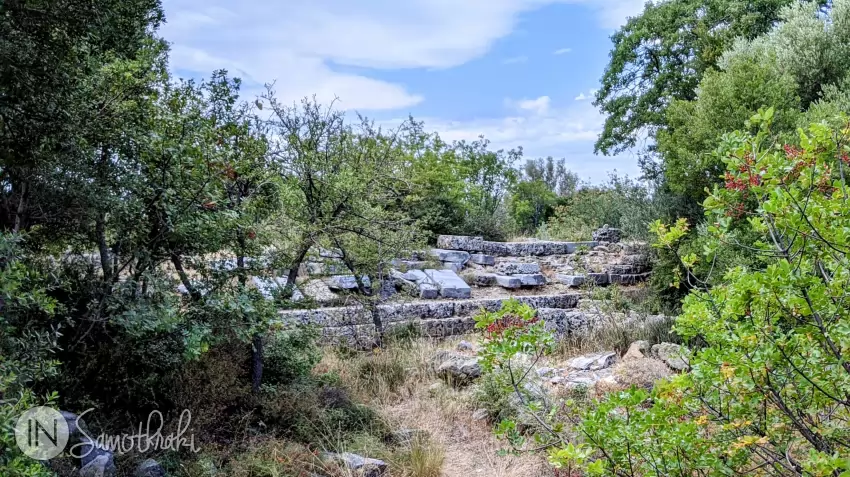
Next to it are the ruins of an older building, begun in the late 4th century but never finished. Right next to that are three ruins of constructions from the late Hellenistic era (2nd century BC), beyond which are the ruins of a medieval fort from the 10th century. It is not exactly known whether it was built for a small garrison or as a shelter for the population facing the threats of pirates.
Neorion
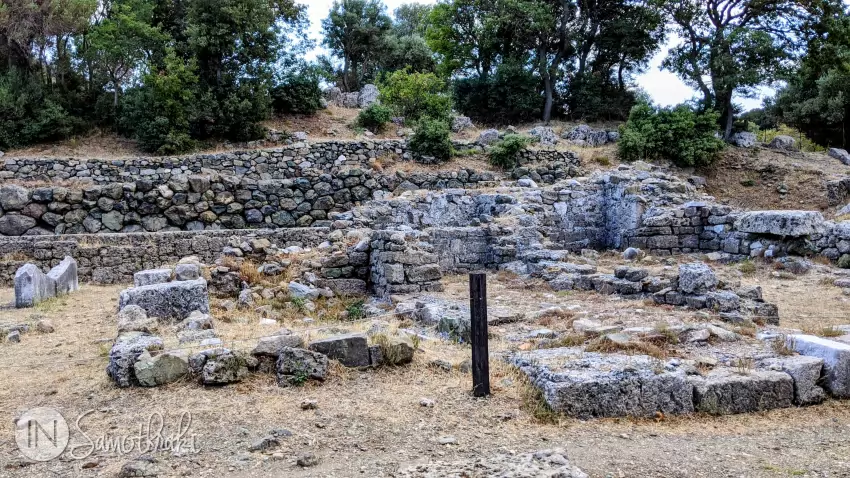
Opposite these constructions, on the left of the secondary path, are the ruins of a small dining hall (hestiatorion) from the 3rd century BC. It had a mosaic-paved floor and 11 couches along the long sides.
Right next to it is a larger building, built during the same period and called the Neorion. This housed the representation of a ship, probably a warship, supported by marble bases, of which a few fragments can still be seen. It is believed to have been a votive gift from Antigonos Gonatas of Macedon. The interior was divided into two by a row of 5 columns.
The "Stone Map" of the Island
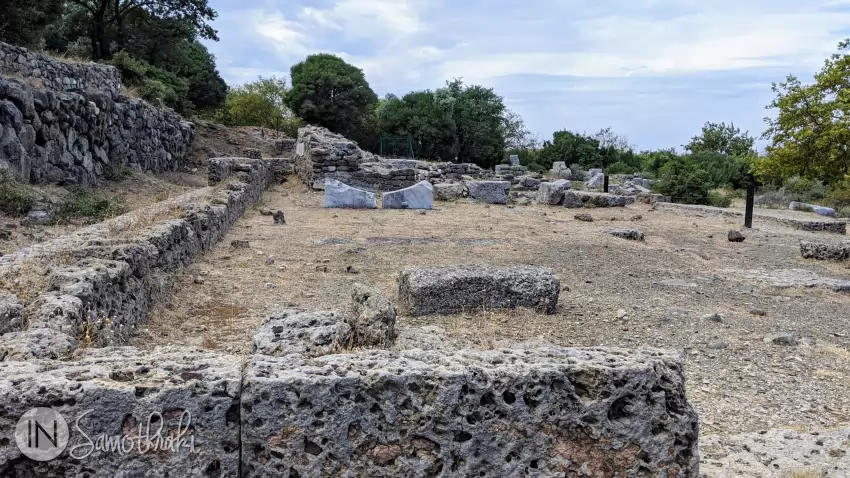
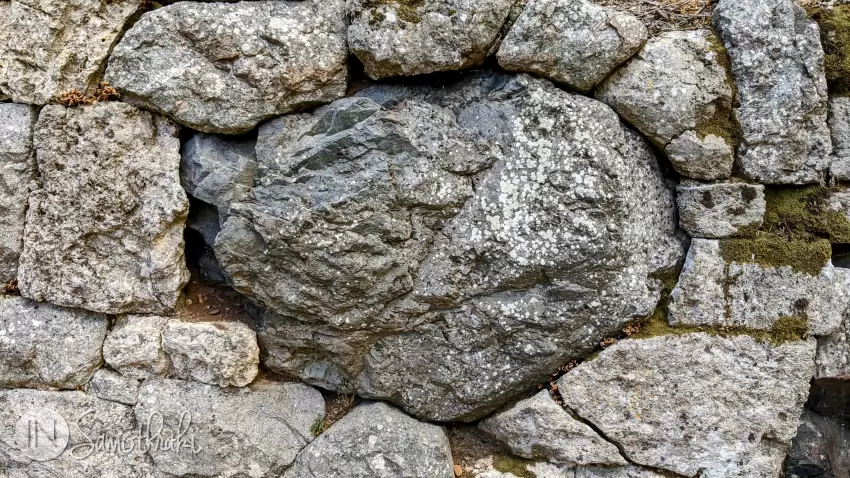
Returning to the main path and continuing the route, you will leave on the right the ruins of dining halls dating from the period between the 4th century BC and the 2nd century AD, as well as the remains of unidentified buildings. Embedded in one of their walls is what some say is the first map of the island, perhaps even the first (stone) map in the world. It is a boulder with an irregular surface, measuring about 1.2 x 0.8 m. Nothing is scientifically proven (no research has been done), but its shape is strangely similar to the distinctive shape of the island, with Akrotiri Cape to the left.
Stoa
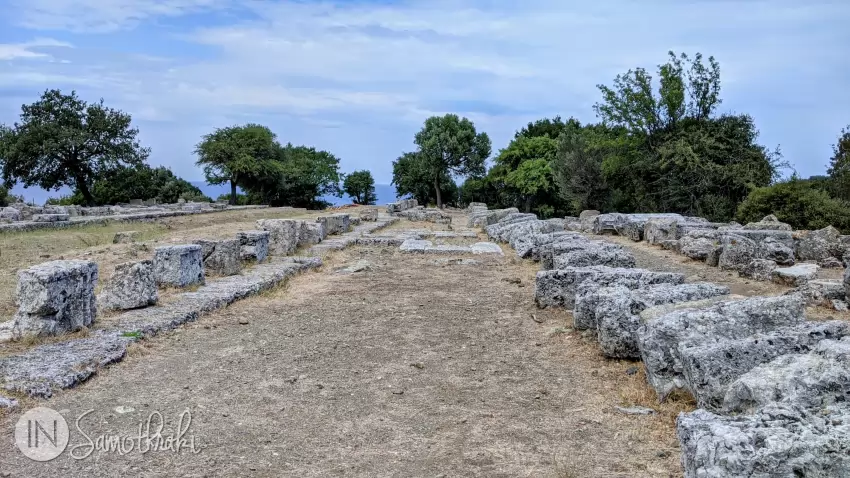
At the southwest end, also to the right of the central path but elevated, is the Stoa. With a length of 104m and a width of 13.4m, it was the largest construction in the Sanctuary. It was also the only building constructed entirely from local materials: limestone from the quarry at Akrotiri, near modern-day Kamariotissa. Its erection required extensive groundwork, both by leveling the higher southern part and by terracing the northern part. The Stoa was built in the first half of the 3rd century to accommodate the numerous pilgrims visiting the temples. To the east, there was a colonnade with 35 Doric columns, and the inner colonnade, with 16 Ionic columns, supported a wooden architrave. The inner walls were painted red, grey, and white, and the exterior, covered with stucco, had the names of the initiated engraved on it. Today, only the limestone foundation remains.
Monument of Nike
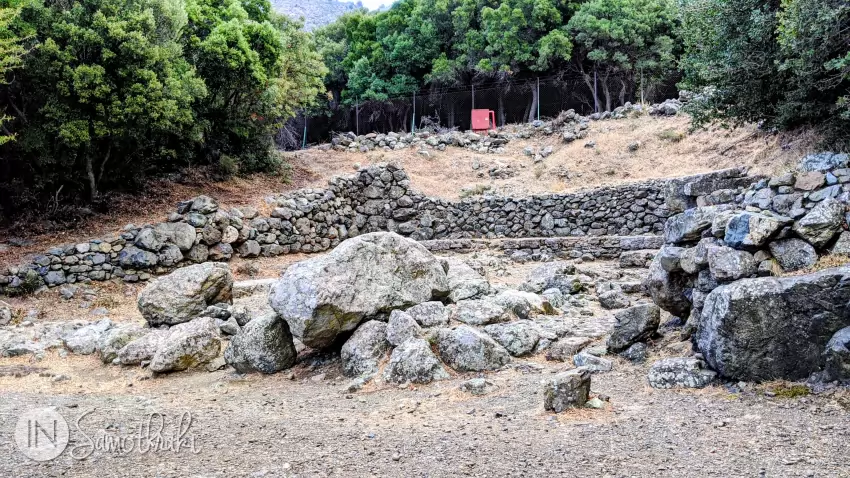
Southeast of the Stoa, in the southernmost part of the Sanctuary, is the Monument of Nike. This is where the famous statue of Nike of Samothrace, now in the Louvre, was placed in antiquity, facing the sea. It was located above the Theatre and could be seen from everywhere in the sanctuary, perhaps even from the water by the ships anchoring in the port of Paleopoli. The rectangular construction, 10x13m, had no roof, and a wall divided the interior into two water basins (the place is also called the "Fountain of Nike"). In the upper, shallower basin was the marble prow of the ship on which the goddess landed with outstretched wings, giving the sensation of floating. Fragments of clay pipes used to supply water or drain the basins were found around the building.
Theatre
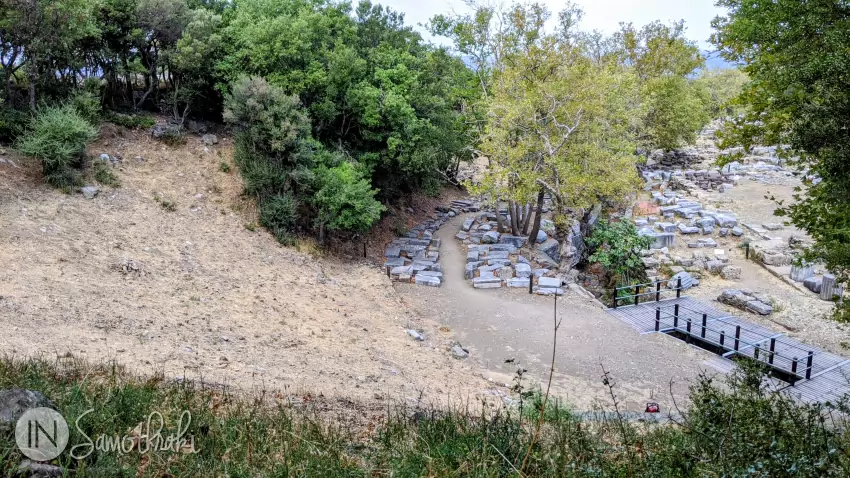
In front of the Monument of Nike was the Theatre, built around the beginning of the 2nd century BC, of which not much remains. It is known to have had 7 tiers separated by 8 stairs. The rows of seats were destroyed between 1927 and 1937; only two seats can still be seen today in its lower part. It is presumed that a temporary wooden stage was built for performances, covering the stream that passed in front of where the spectators stood. At the annual ceremonies, the theatre hosted representations of the mythical marriage of Kadmos and Harmonia, the abduction of Persephone by Hades, as well as Dionysiac games.
South Necropolis
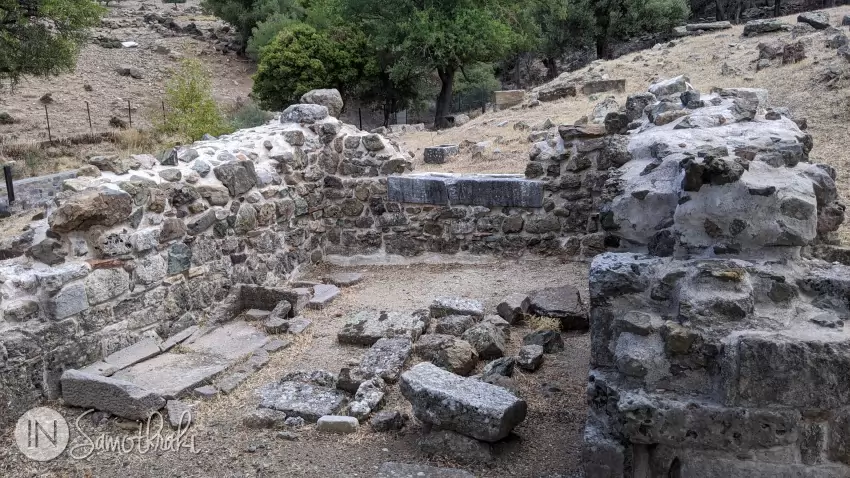
Leaving the Monument of Nike on the right and following the secondary path, you will reach the South Necropolis, where about 400 graves, both inhumations and cremations, dating from several eras, starting with the Archaic (7th century BC) and extending to the Roman period (2nd century AD), were found.
Propylaeum of Ptolemy II
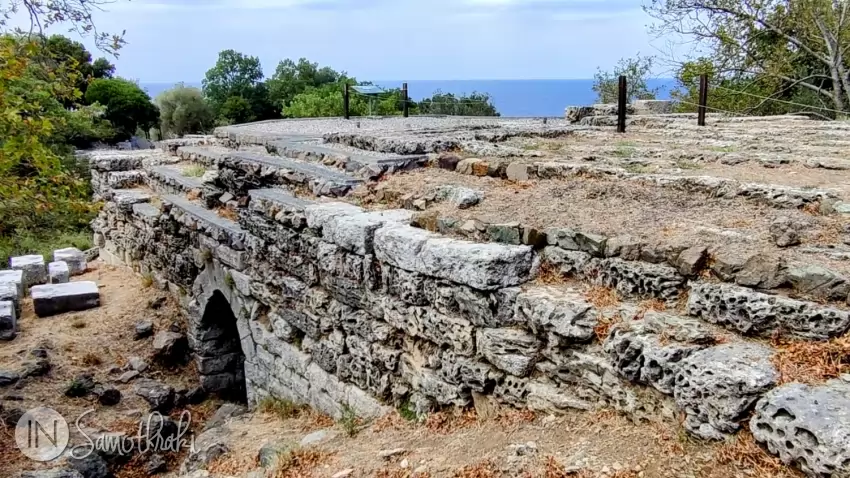
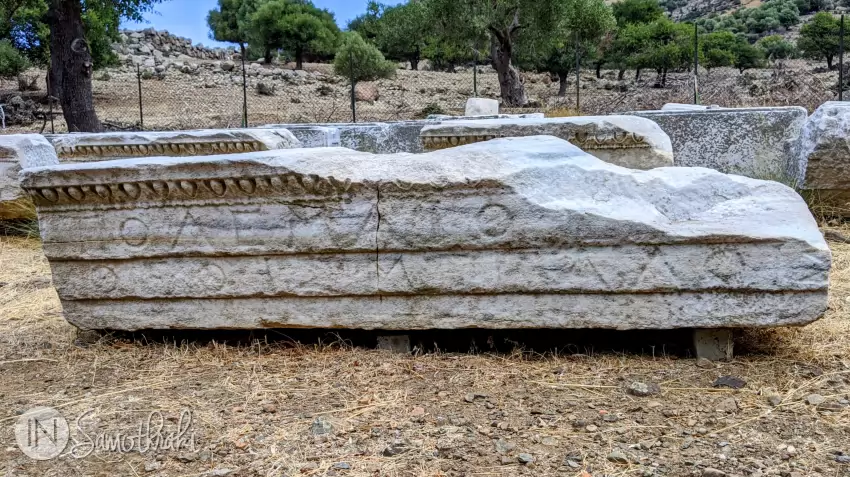
Continuing along the path, you will reach the Propylaeum of Ptolemy II, which in ancient times constituted the official entrance to the sanctuary from the ancient city. The Sacred Way, which connected the sanctuary to the city, began here. The Propylaeum was built between 285–281 BC by the ruler of Egypt, Ptolemy II Philadelphus. The building, one of the most beautiful and imposing in the sanctuary, consisted of two monumental porticoes of white Thassos marble, one on each side, connected by a wall with an entrance in the central part. The eastern portico, facing the city, had 6 Ionic columns, and the one facing the sanctuary had 6 Corinthian columns. The architrave bore an inscription on both sides stating that the propylaeum was a gift from Ptolemy II to the Great Gods. The frieze above was decorated with rosettes and bull heads. Today, only the base of the building remains, crossed by a vaulted channel that drained water towards the river that crossed the eastern part of the sanctuary.
Sacred Circle (Theatrical Circle)
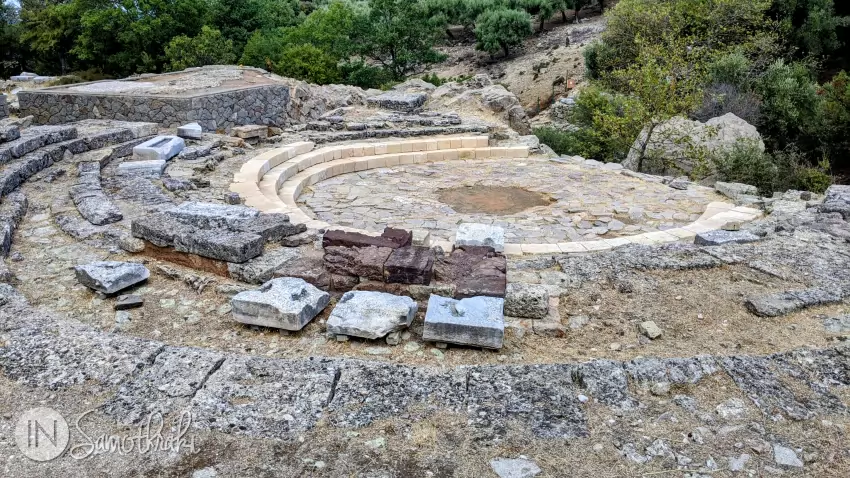
Below this is the so-called Sacred Circle or Theatrical Circle, a paved circular area with a 9m diameter, surrounded by 5 rows of steps. It dates from the 5th-4th century BC and was probably used for the preparatory ceremonies for initiation, where sacrifices were made and ritual performances were enacted. Given that the steps are too narrow for spectators to sit, it is believed they stood. The capacity was about 240 people. In the center was a marble altar, and among the rows was a sacred porphyry rock for libations. An opening led to the Hall of the Dancers, located below. The foundations of several statues were found around this circular area, all being offerings to the Great Gods by visitors to the sanctuary.
Monument of Philip III and Alexander IV
To one side is the Monument of Philip III and Alexander IV, built in 323-317 BC by the successors of Alexander the Great, as indicated by the votive inscription on the entablature. The building, made of Thassos and possibly Paros marble, had a mosaic floor and 6 Doric columns on the west façade, and its purpose remains unknown. It collapsed during an earthquake at the beginning of the Common Era and was never reconstructed.
Doric Rotonda
Continuing down the old paved road and turning right, you will reach the Doric Rotunda, a small circular building constructed in the second half of the 4th century BC, probably intended to serve as a funerary monument. Today, its foundations are covered by vegetation.
Anaktoron
From here, the path leads to the Anaktoron ("Palace"), which has a small square room to the southeast, 7x7m, called the Sacristy or Holy House. According to one theory, this is where the faithful prepared for initiation, donning ceremonial clothing and receiving an oil lamp each. Inside, there were marble benches, and the walls were engraved with the catalogs of the initiated, fragments of which still survive today. The structure was erected in the 1st century AD and rebuilt in the 4th century.
Next to this, the Anaktoron is one of the oldest buildings, built in the late 6th century BC on the foundations of an older construction. It continued to be used until the end of the Sanctuary's operation. Eight pillars, four on each long side, supported the roof, and on the west side were three doors, one principal and two secondary. Inside, to the north, was a sacred enclosure with a raised floor, at the entrance of which was a marble plaque with the inscription "Let no uninitiated enter", which forbade entry to the uninitiated. With the arrival of the Romans, the inscription was also added in Latin. In front of it was a wooden screen, sacred rocks, and two bronze statues of the Kabeiroi with raised hands. Along the north and east walls were wooden benches, and to the south was a sacred rock for libations. On the south side, the walls are still preserved today up to a height of 3m.
Rotunda of Arsinoe II
Next to the Anaktoron is the Rotunda of Arsinoe II, considered the largest covered circular structure in ancient Greece. It was one of the most imposing buildings in the Sanctuary, with a diameter of 20m and wall foundation thickness of about 2.5m. It was built between 288-270 BC by Arsinoe II, wife of King Lysimachus of Thrace and sister of Ptolemy II of Egypt, as an offering to the Great Gods. Sacrifices and official gatherings took place here during the annual religious ceremonies.
The Rotunda had a total height of 12.65m and 2 richly decorated floors on the exterior - one enclosed, with a monumental gate to the south, towards the Temenos, and the other consisting of a gallery with Doric pilasters supporting the entablature where the votive inscription appears, fragments of which still remain. Between the columns, at the base, were parapets decorated with rosettes and bull heads (you can see reconstructed fragments at the Archaeological Museum). The roof, initially conical and later rebuilt in an octagonal shape, was decorated with acroteria and lion-head spouts.
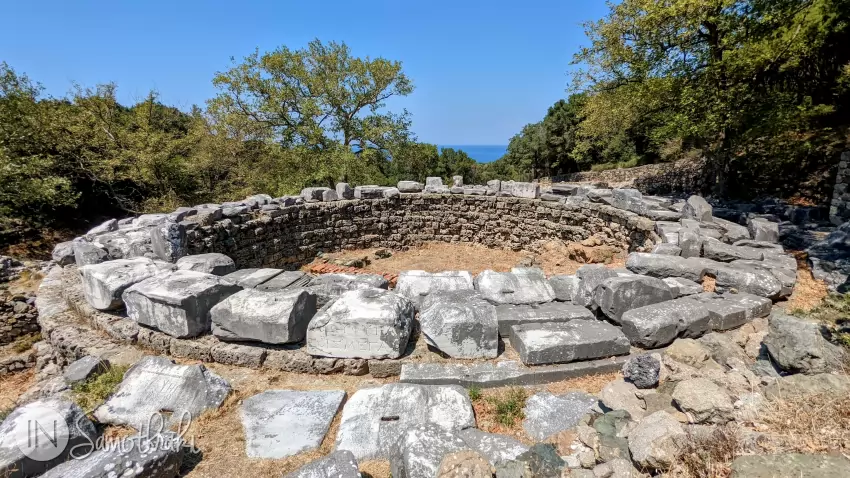
Inside the Rotunda's foundation are the ruins of the Orthostate Structure, dating from the first half of the 4th century BC and used for the first phase of initiation. It gets its name from the large stone blocks.
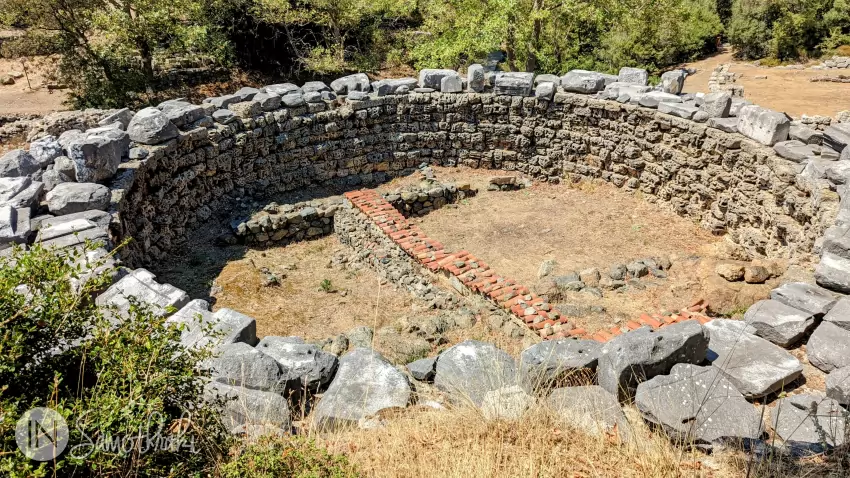
In the southwest part, in front of the Rotunda's entrance, is the Sacred Rock, a large volcanic porphyry rock with blue-green hues. It is one of the oldest structures of the Sanctuary, existing even before the arrival of the Greek colonists, and was used as an altar for the veneration of the Great Mother Axieros.
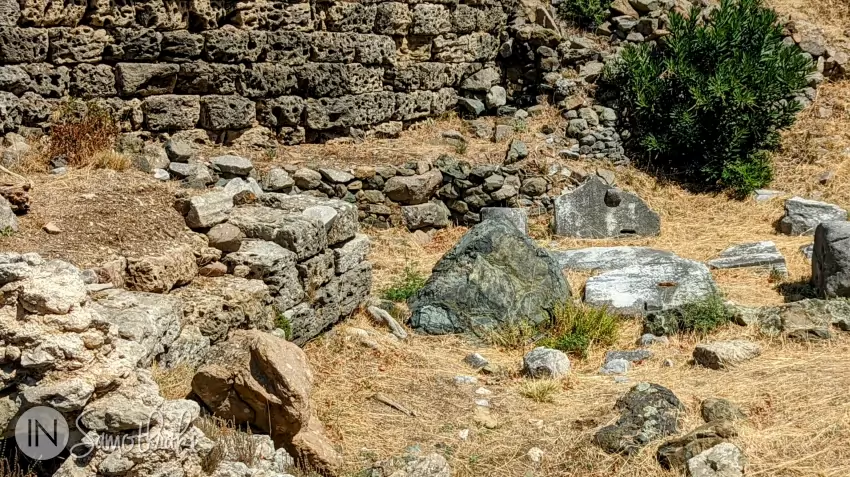
Hall of Dancers (Temenos)
In front of the temple, right in the middle of the archaeological site, is the Hall of the Dancers, also known as the Temenos. It was built around 340 BC, probably by Philip II, and was the oldest and largest (24x10m) of the monumental marble buildings of the Sanctuary. It occupied a central place in the cult of the Great Gods, being used for religious ceremonies. The frieze with the bas-relief representation of the dancers holding hands was found here, giving the construction its name. Ritual dances representing the mythical marriage of Harmonia and Kadmos likely took place inside the building. The temple had two long rooms, a marble floor, an 11-column Ionic colonnade, and places for offerings and libations. The ceiling was decorated with sculptures of Samothracian deities, probably created by the sculptor Skopas. The ceremonial road on the eastern hill ended near the north end of this building.
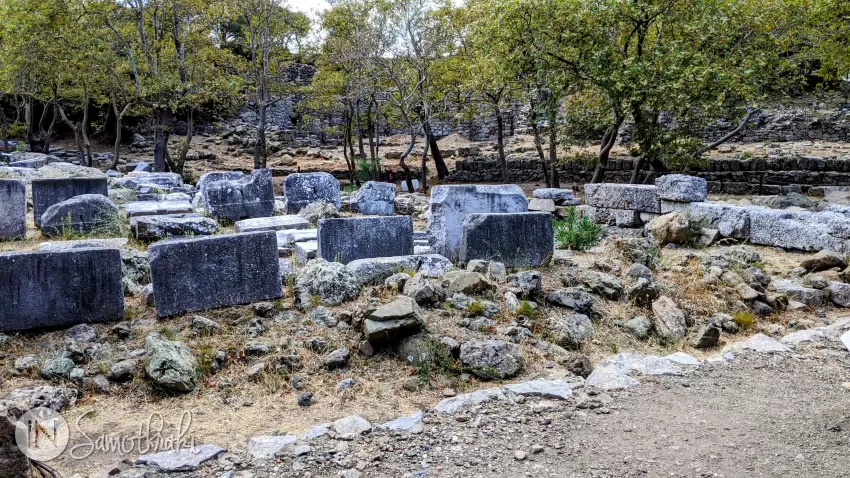
Hieron
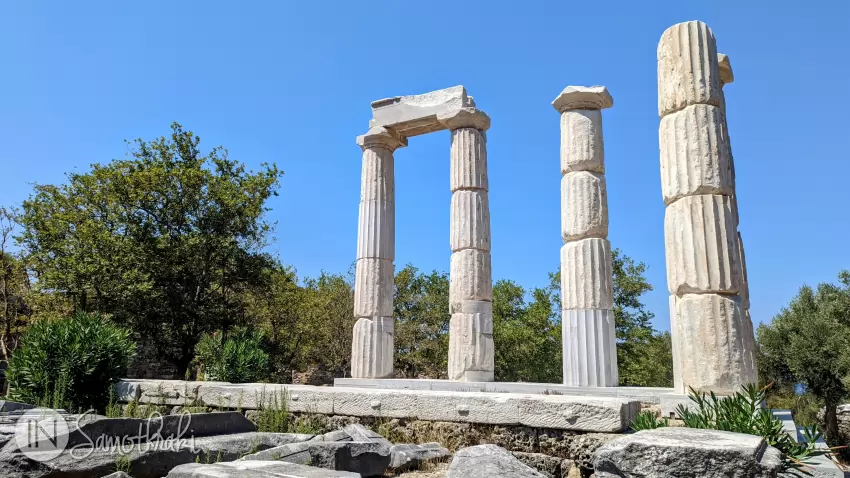
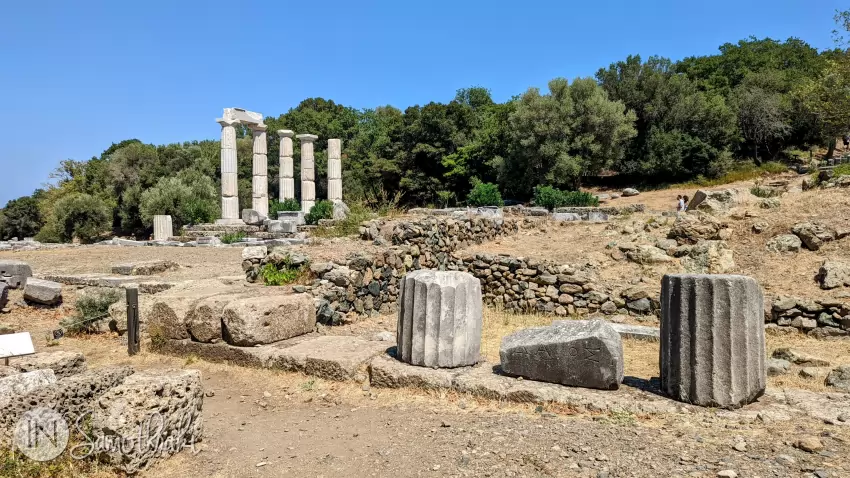
Next to the Temenos is the Hieron, probably the building in the Sanctuary that will impress you the most. The 1956 restoration of a few columns, partially using the approximately 800 fragments scattered around, allows you to imagine how it might have looked in antiquity.
It was an imposing, richly decorated marble building, measuring 40x13m, constructed around 325 BC on the site of two older buildings. It was completed later, around 150 BC, when the facade with two rows of 6 Doric columns, separated by one column on the side, was added. In the central part of the entablature was a floral decoration, and at the ends were two statues of the goddess Nike. The roof was made of wood and tile. When archaeologists discovered it in the 19th century, they called it the "Doric Temple." After the Temenos was discovered, they renamed it the "New Temple." Later, specialists' opinions changed: the Hieron was not a temple but the place where the second phase of initiation took place.
Entry to the building was through a main door on the north side and two side doors. An inscription prohibiting access to the uninitiated was also here. Two stone blocks remain where the initiate and the priest to whom they confessed their sins stood. Along the long walls, painted black, red, and white, were two rows of marble benches. To the north was a hearth for sacrifices, and the animals to be sacrificed were brought up a ramp at the entrance. The southern part formed a small apse with a wooden roof, and in the marble block in front was a semicircular opening for libations. The construction of the building may have been related to the interest of the Macedonian Emperor Philip II in the Sanctuary of the Great Gods. More recent excavations have led archaeologists to revert to the initial opinion - the Hieron may, after all, have been a temple.
Altar Court
Right next to the Hieron is the Altar Court, built between 340–330 BC. It was a roofless building, enclosed on three sides, with a Doric marble colonnade on the west facade.
Fragments of an inscription were found on the entablature of the colonnade, indicating that the building was most likely dedicated to the Great Gods by Philip III Arrhidaeus, the half-brother and successor of Alexander the Great. Inside the mosaic-paved building was a large marble altar, built over an Archaic altar of rocks. A fragment of a clay pipe used to drain the blood of sacrificed animals was also found.
Hall of Votive Gifts
The Hall of Votive Gifts is an extension of the Altar Court. Archaeologist Karl Lehmann dates it to around 540 BC, but today's specialists state that it is no older than the 5th century BC. The purpose of this construction was to store and display the gifts brought to the gods. It had a Doric colonnade on the facade facing the theatre.
How Did the Initiation Ceremonies Unfold?
Now that you are familiar with the main buildings of the sanctuary, you can try to imagine how the initiation ritual took place. Although its content remains unknown, the documents, studies, and research conducted have contributed to outlining a general picture. You can also be aided in this by the reconstructions made by Emory University in Atlanta or by National Geographic.
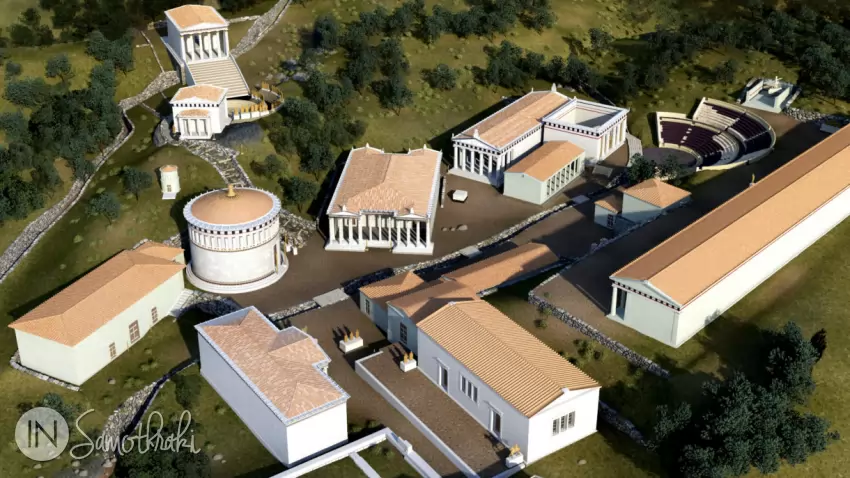
The person wishing to be initiated into the Mysteries of the Great Gods entered the sanctuary at night, from the ancient city, passing through the gate of the Propylaeum of Ptolemy II. From there, they descended to the Sacred Circle, located on the other side of the river, where some sort of introduction likely took place, and they attended the preliminary rituals. Blindfolded, they then descended the Sacred Way, which led to the Rotunda of Arsinoe and the Hall of the Dancers. Along the way, they had to pass various tests and trials in search of the goddess Harmonia. Finally, when the blindfold was removed, they experienced an extraordinary revelation, saw the sacred light, and witnessed the ritual spectacle of the marriage of Harmonia and Kadmos, which took place in the Hall of the Dancers. This marriage was represented on the frieze that surrounded the entire building.
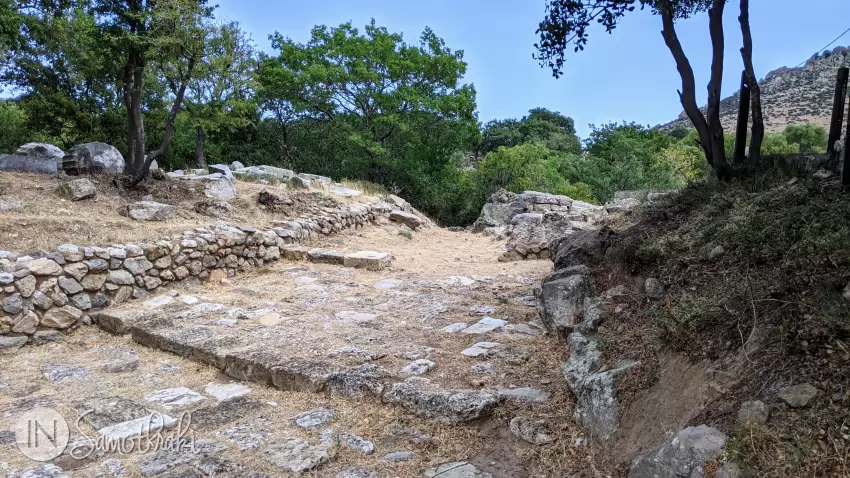
Until recently, it was believed that the preparation took place in the Holy House, where the participant received ceremonial clothing and an oil lamp, that the first stage of initiation was conducted in the building called the Anaktoron, and the second in the Hieron. The most recent excavations have revealed that the initiation took place in the Hall of the Dancers, that the Anaktoron was most likely used for assemblies, and that the Hieron may have been a temple.

 Chora, the Perched Capital of Samothraki
 Panagia Krimniotissa, the Church on the Rock
 Therma - Mountains and Sea in Samothraki
 Kamariotissa - Welcome to Samothraki!
 Nike, the Winged Victory of Samothrace